Written By
Ryan LeClaire
Published On
April 23, 2026
Did you know that 76% of homeowners feel competitive about their lawns? But only 23% of those people feel like they’re winning.
As a company that specializes in helping our customers win the neighborhood, we can tell you that proper lawn aeration to break up excessive thatch can make all the difference.
Customers often come to us with questions about dethatching. They may ask, “Should I do my own dethatching? How is that different from aeration? Is it better?”
There are several crucial differences between them, and a right time and place for each. So, to help you try to grow your best lawn ever, let’s take a deeper look at both lawn dethatching and lawn aeration so you can figure out which one is right for you.
Thatch is a tightly woven combination of both living and dead organic materials, such as:
It sits on top of the soil and beneath the visible grass blades. In most cases, a bit of thatch can be a good thing. For example, the right amount of thatch can:
However, you don’t want to let thatch get any thicker than 1/2 to 3/4 of an inch (1-2 cm), because too much thatch can lead to many issues with the lawn. If the lawn has excessive thatch, it will encourage pest and disease issues. It will also make it more difficult for water, air, and nutrients to reach the soil, leading to shallow roots.

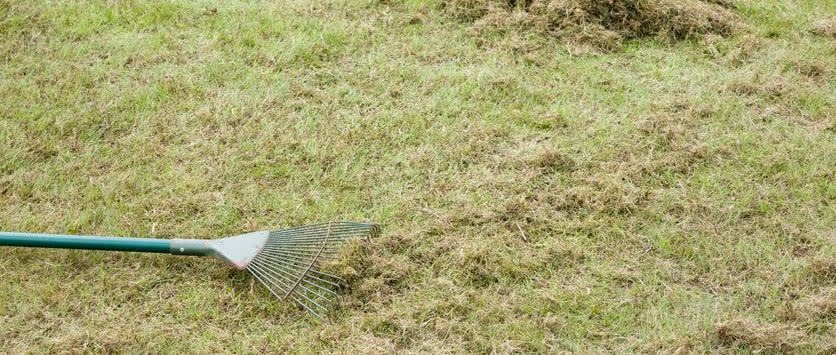
Your best bet is to simply use a fan rake, and don’t rake too hard. However, if you’re still having problems, you might consider a lawn aeration. In fact, an annual aeration can make a major difference, whether you’re having problems or not.
We have seen some homeowners almost ruin their lawns with dethatching gone wrong, and many needed a full year to recover from the damage. Again, a healthy lawn needs a thin layer of thatch, and removing it can leave you too exposed. At the same time, it’s hard to stop a dethatching machine from also removing crowns, leaves, or even the roots of grass plants.
You may have also heard it called lawn mechanical aeration or core aeration. These are pretty much the same thing.
They all describe the process of removing small cores of soil and thatch from your lawn with the goal of:
How often should you aerate your lawn? In most cases, we would say you should do it at least once a year. But you may want to bump that up to twice a year if your lawn is dealing with:
It’s also a good idea if you’ve purchased a home recently and inherited some lawn problems from the previous owner.
And of course, it can really give you amazing results if you want to take your lawn from good to great. A lot of people who want the best lawn in the neighborhood will aerate once in the spring and then once again in the fall.
Using a piece of equipment that looks like a heavy-duty lawn mower, aeration pulls small plugs up and out of the soil, opening channels that allow air, water, and nutrients to reach your grass roots. These plugs (also called “cores”) are left on your lawn's surface until they break down naturally.
We typically recommend aeration for thatch-heavy lawns because you’re doing more than just stripping away the layer of thatch (or sometimes more) completely. You’re actually opening things up for your lawn to use the thatch in a healthy way, while ensuring your lawn can still “breathe” and soak up what it needs to thrive.
In certain regions (including Canada and the northern U.S.), Weed Man will perform a mechanical core aeration in combination with overseeding.
Overseeding is the process of spreading seeds across your lawn to help it fill back in. When we aerate, the holes we leave behind allow the seeds to fall deep into the soil and germinate, resulting in a thicker, healthier lawn!
Dealing With Excessive Thatch? Weed Man Can Help!
Don’t accidentally strip away the healthy organic materials your lawn needs to thrive. Get an expert lawn aeration to open things up and grow your best lawn ever.
“I contacted Weed Man Lawn Care late spring 2025 because my lawn was full of weeds, plantain, and dandelions, mostly, and a lot of clover. In addition, the lawn was in poor shape and sparse. Weed Man fertilized and treated the weeds throughout the spring & summer, and then aerated and overseeded the lawn this fall. Even after this summer's drought, I now have a very healthy and lush green lawn.” - 5 Star Google review.
You can start right now by telling us a little bit about your lawn.
Written By
Ryan LeClaire
Published On
April 23, 2026
I walk my neighborhood two times per day with my German shepherd, Kai. She enjoys the smells and visiting a few friends; I enjoy the extra few calories I burn that can later be replaced by chocolate d...

Not too long ago, Lubbock won The Weather Channel’s contest for “America's Toughest Weather City.” And when you live in America’s Toughest Weather City, that means your lawn has to stand up to:
Some people want to hold the title of undisputed lawn champion of their block. To them, lawn care is a competitive sport, and they’re in it to win it.

