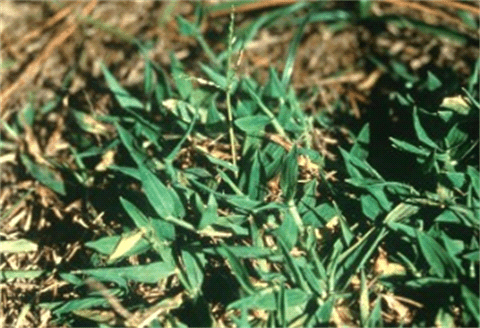
Both Blanket Crabgrass and India Crabgrass are undesirable because of their coarse texture, unsightly colour, and weakness of the plant’s structure. These characteristics do not blend well into a fine textured, dark green, healthy lawn. Once these grasses die off, they leave behind thin or bare patches, which will need to be renovated.
Blanket Crabgrass is commonly found in lawns in the southern United States. It is known for its ability to grow and spread rapidly, hence its name: “Blanket” Crabgrass. It can grow up to 12 inches tall and has a branching stem with hairy leaves that are light green in colour. The leaves are arranged in a spiral pattern and are very rough to the touch. Blanket Crabgrass is a summer annual or short-term perennial with creeping stolons that produce large quantities of seeds, which can last in the soil for several years.
India Crabgrass is a warm-season grass that has a low growth habit and spreads to form a dense mat that can smother other plants. The leaf blades are quite short, usually about 1 inch long. The most significant difference between India Crabgrass and Blanket Crabgrass is that the sheaths and blades of India Crabgrass are smooth. India Crabgrass is usually found in dry sites, whereas Blanket Crabgrass favors moist to wet sites.
An effective way to control small infestations of these invasive weed grasses is to pull up individual plants by hand, before seed heads are produced, and then repair these areas with desirable grass seed varieties or sod. If the infestation is larger, other forms of control may be necessary. Preventative applications can be applied for Crabgrass, but the products that are available will vary by region.
A thick, healthy, well-maintained lawn is always the best line of defence. This can be achieved through beneficial cultural practices, which include:
Recommended Mowing Height
Common Bermudagrass - ¾ to 1¼ inches
Hybrid Bermudagrass - ½ to 1½ inches
Centipedegrass - 1 to 2 inches
Zoysiagrass - 1 to 2½ inches
St. Augustine - 3 to 4 inches
Fescue - 3 to 4 inches
Your local Weed Man professional will be able to offer other solutions and recommend the best form of treatment that is suitable to improve the conditions of your lawn
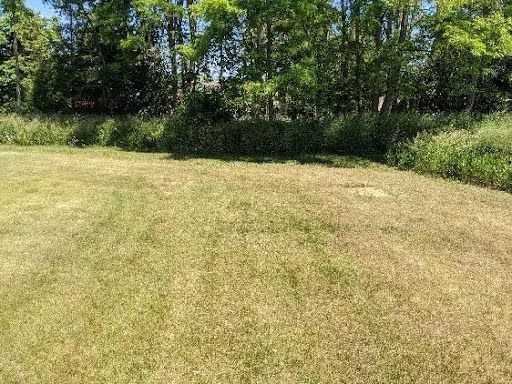
Drought stress refers to the negative effects on a lawn when there is not enough water available for the grass to properly grow and thrive. This can cause the grass to turn brown and dormant, while al...
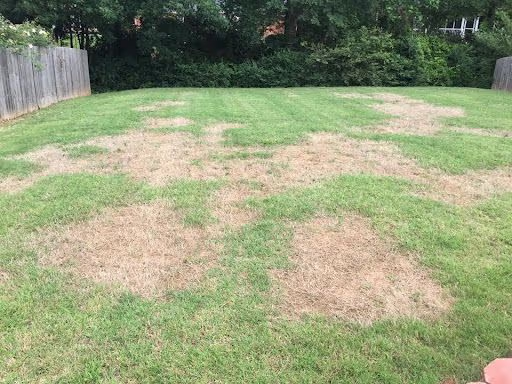
Take-All Patch, also called “Root Rot,” is a common fungal disease that affects the roots of grass plants, particularly in golf courses and lawns. It attacks lawns that are already stressed, weakened,...
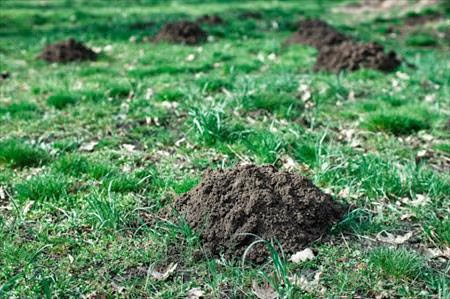
The adult mole is a small, burrowing mammal, commonly found in lawns and gardens. It has dark gray or brown velvety fur and a cylindrical body that is 15 to 20 cm (5 to 8 inches) long. It has small ey...

