Written By
Ryan LeClaire
Published On
March 5, 2026

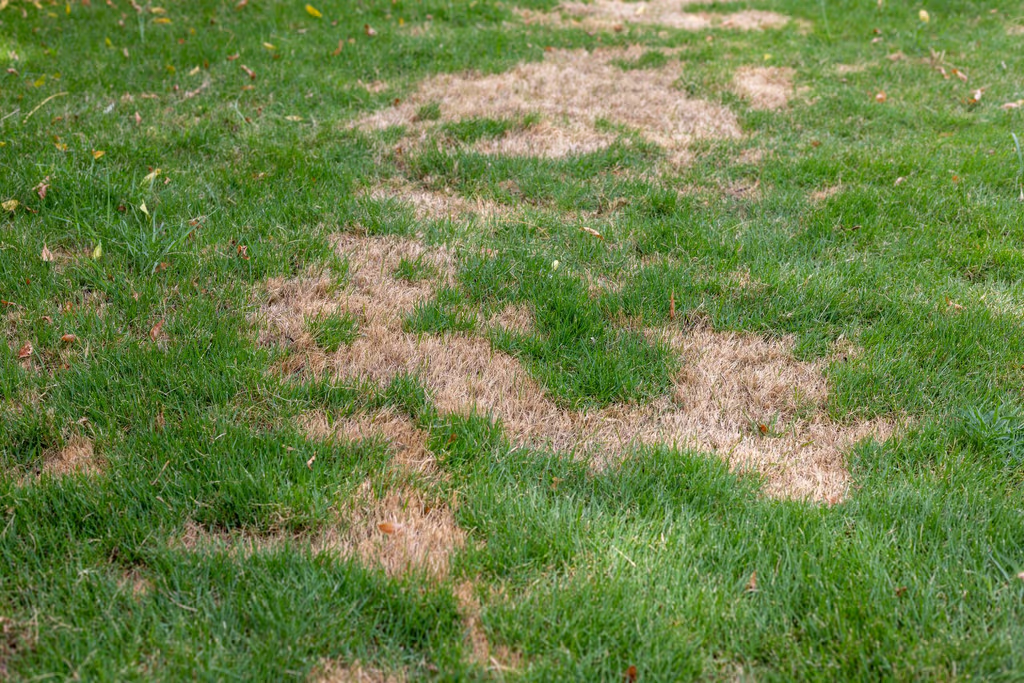
This is the time of year when we frequently get calls from concerned homeowners. Their lawns are not greening up as quickly as expected. Brown patches are throwing up red flags of concern.
This is not unusual, or necessarily a reason to worry. The South is going through a delayed spring green-up across the board.
So don’t worry, your lawn is most likely fine. It’s just running a bit behind schedule due to an extended stretch of cool spring weather, and this has kept soil temperatures too low for warm-season grasses to fully wake up.
It’s important to remember your lawn doesn’t care about the calendar. Green-up is determined by soil temperature. This means consistently warm nighttime temperatures in the 50s, 60s, and above.
But right now, our nighttime temperatures are in the unseasonably chilly 40s, so we’re not seeing the full green-up you may be used to.
The good news is that, once warm weather arrives (for good), your lawn will green up soon enough.
If you’re seeing any of the following things in your lawn right now, it’s not time to panic.
Areas that receive more sun or warmth will green up faster than shaded or low-lying areas. This includes turf near:
These areas will stay damp and spongy the longest.
Don’t worry! In most cases, your grass is just dormant, not dead. Particularly if you have the following types of grass:
We know it doesn’t look great right now. But you can safely wait a little longer before you start worrying.
Just because we’re experiencing a slow or delayed green-up doesn’t mean there’s nothing you can do.
It’s important to remain patient and remember that every yard is different. Even if you start to see your neighbor’s lawn start to green up, don’t panic yet.
Each lawn’s respective green-up will be impacted by dozens of factors, including:
Even the healthiest, most well-maintained lawn will not start actively growing until nighttime soil temperatures are at least 65 degrees.
Proper mowing is absolutely essential in developing and maintaining a healthy, thick, and green lawn.
You can cut Bermuda all the way down AFTER the threat of frost has passed. However, we do NOT recommend cutting Zoysia right down, unless you are prepared for the recovery.
As for Zoysia, Centipede, and St. Augustine, we recommend cutting down to your desired summer mowing height, but don’t cut it right down. Also, bag on the initial cut of the season. After that, cut at least once a week, and no need to bag.
Ensure the lawn receives at least one inch of water each week once it's actively growing.
We've been fortunate to get sufficient rain lately, so it hasn't been an issue. But we don’t have to tell you that this can change without warning.
Placing a rain gauge or an empty tuna can on the lawn will help measure rainfall/irrigation.
Aerating the lawn every year, or at least every other year, will work wonders for your lawn.
Aeration pulls plugs of earth from the ground, which sets you up for more absorption of water, air, and nutrients in the soil. Simply put, more water reaches the roots rather than being lost to runoff in compacted soil.
It also means a higher percentage of nitrogen is absorbed rather than lost, resulting in greener grass. Finally, it helps roots grow deeper, resulting in a stronger root system that better withstands heat, cold, and other stressors.
To see the difference a professional aeration can make, click here.
You can’t control the weather, but you can control a lot of the things that may be hurting your grass and your green-up.
Now is a great time to take a good look at your yard and look for areas to improve and set it up for success.
Weed Man specializes in taking a look at what you’re working with and showing you exactly how you can grow the best lawn on the block. We only provide customized solutions, not cookie-cutter packages.
Want to see what we can do for you? Start right now by telling us what’s wrong with your lawn.
Written By
Ryan LeClaire
Published On
March 5, 2026

Stop watering your lawn every day! It’s not helping, and it may actually be encouraging weed growth.

Spring & Summer tend to be much more enjoyable when Mother Nature gives us plenty of sunshine. Rain and thunderstorms are fun to watch, but they prevent us from doing a lot of things we love.

One of my favorite weeks of the year is the first week of April. The days are getting longer, temperatures are increasing, the birds are officially back from their trip down south, and a little golf t...

